Orkney - The Isle of Rousay


Happy Easter 2022! We met this pair in a churchyard near Midhowe Broch  on Rousay yesterday. The little one was still wobbly kneed.

For all the churches closed on Friday, it was a strange contrast Saturday that all the Neolithic sites were open. I suppose not so many people enjoy crawling around in burial cairns, or perhaps, they are simply better cared for because so many people DO like crawling around in them!

We visited four Neolithic Stalled Cairns on Rousay, all of which were accessible. They are stunning examples of the ingenuity, creativity and drive alive in humans since the dawn of time. All the cairns were constructed 3,500 years ago and consisted of "stalls" where bodies were laid, ashes were placed and bones collected over the millennia, a testament to the honor and care of ancestors and deceased.

Some photos:


These cairns were capped with concrete roofs containing sky lights. While this preserves the stone building, it also promotes the growth of alga and lichen in the damp and sunlight.


Beautiful resting place; the fog was low and the walks misty.


Most of the day was spent at Midhowe Chambered Cairn, Midhowe Broch, Midhowe Farm, St. Mary's Church, Viking farm ruins and an 18th century farm ruins.

Midhowe Cairn is known as The Great Ship of Death. Covered by a hangar, the site has catwalks so that tourists can view the chambers and experience the magnitude of the site.


The Broch constructed in about 1100 by the farmer who worked the fields here. Perhaps Sigurd from the Orkneyinga Sagas.


As the walls of the broch began to slide, heavy slabs were set against the slipping wall - on the left - as buttresses.


The entire seascape around the broch is this slabbed stone, clay laid down in the seabed of the great Orcadian Sea in the Devonian Period, similar to our own Lake Bonneville.


We didn't make it to Eynehallow, the mysterious disappearing island. Here is video of the tidal race between Rousay and Eynehallow.


Midhowe Farm, perhaps farmed by Sigurd.


St. Mary's Church, desperately close to falling into the sea, the site of the lamb birthing.


Skaill Farm with an excavation of a possible Viking Long House in the front.


An example of a bere kiln, typical of all Orkney farms of the period. Bere is a form of multi-row barley which had to be dried in order to perserve it for porridge, bread and brewing.


We drove out to the Shop on Rousay for souvenirs; it is closed on Saturdays.


Orkney - The Isles of Egilsay and Wyre

Today dawned damp and cloudy, or was it mist? Our first walk on ferry ride from Tingwall to Egilsay was stuffed with working vehicles. We watched it being loaded, certain something would get hurt. We also watched the ferry bring mail and deliver fresh milk to the outlying island.

Our visit to Egilsay was to see St. Magnus Kirk and other things St. Magnus. We saw the church, and were disappointed that it was closed to exploring due to structural weakness.


This form of church building is typical of churches in Ireland, not Scotland. The round tower may have been used as much for defense or observation as a belfrey.

We were obviously not the only visitors to the site of Magnus' killing. It is said the field turned immediataly green as the axe split his skull.

We took respite in the Egilsay Community Hall where electricity, wi-fi and the makings for tea afforded a nice break for lunch.


St. Magnus Beach.

We caught the ferry to Wyre for all things Cubbie Roo, the Anglicized name of Kolbein Hruga, a "very able man ... farming on Wyre in Orkey. He had a fine stone fort built there, a really solid stronghold." (Orkneyinga Sagas)

This was our day for "monument is closed". Perhaps they are having some sort of pandemic? St. Mary's Church was also closed for exploration.


So we sat on the wall and enjoyed a mid afternoon snack. The sun had burned through the low clouds just for us on Wyre!


Cubbie Roo had a stronghold, but first he was a farmer. The farm on the left, below, may have been the site of his farm. St. Mary's Church is the walled structure on the right.


We've seen a lot of castle ruins; this is the first with a moat with water in it!


Presumably the kitchen as it has a great stove in it.


Curved castle enclosure and walls.


Waiting in the spartan ferry terminal guest lounge for our ride back to Tingwall.


Orkney - The Isle of Eday

Today was gloriously sunny and clear, and after some mostly cloudy and rainy days, we needed it for our mental health and the trip to Eday.

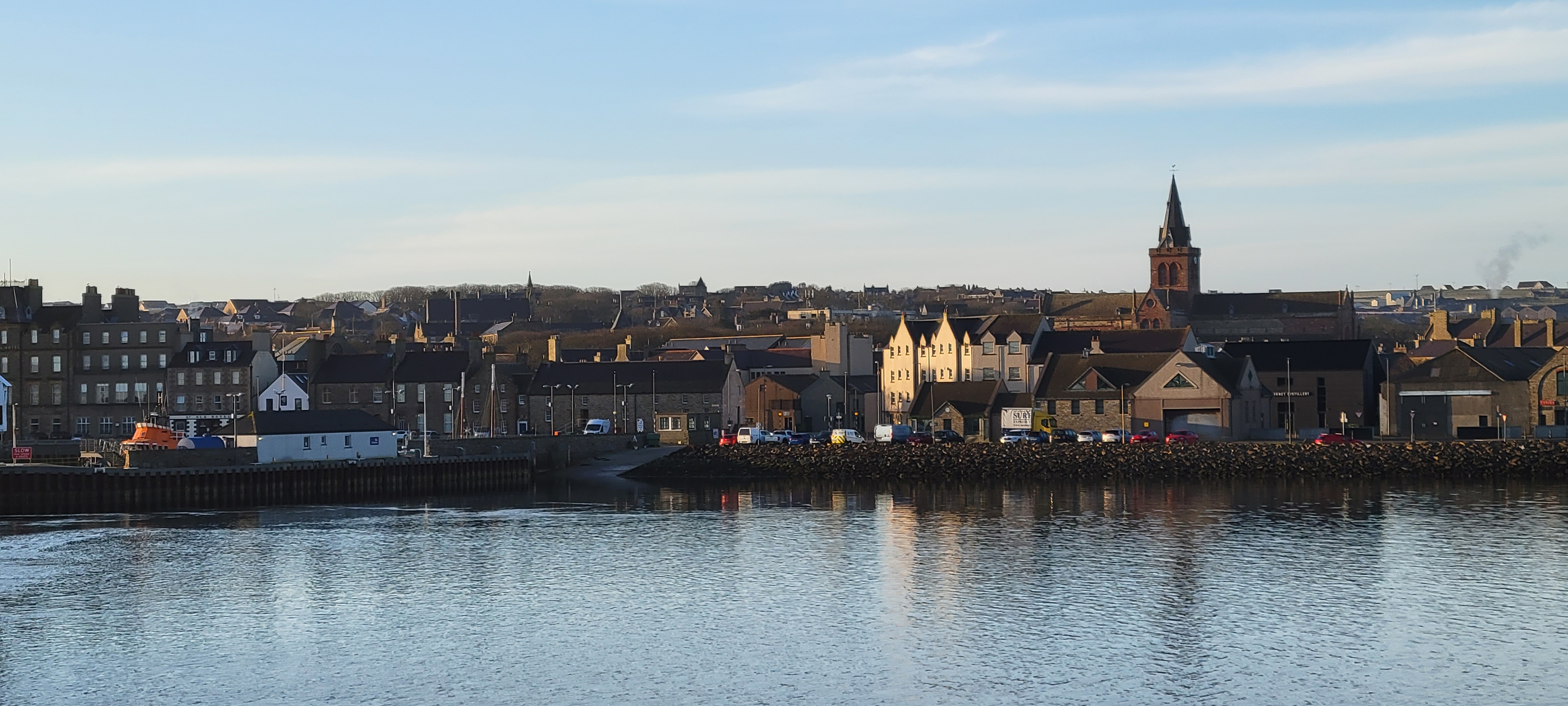
View of Kirkwall from the departing ferry.


The ferry made a stop on the Island of Stronsay before we reached Eday.


Our first view of the Setter Stone on Eday. This standing stone is said to be the tallest stone on Orkney.


Lichen covered, standing on the edge of Mill Loch, in the middle of the island. Why?


Our goal was Vinquoy Cairn and along the way we passed Braeside and Huntersquoy Cairns. These have been heavily robbed of stone and artifacts; the only thing left at Braeside are the rocks too large to move!


Vinquoy Cairn was pretty amazing. It has a "sun roof" so that the inside is NOT like a cave and definitely not scary. It was a tight squeeze, but we both made it in and back out.


Views from the Trig Point on Vinquoy Hill and the walk down. Amazing color; stunning views.


Sun setting on the ferry ride back to Kirkwall.


Orkney Mainland Day 3

A quick post tonight as we are heading out early tomorrow to the island of Eday.

It rained most of the day today so we decided to do "inside" things such as shop (my Christmas is done!), museum and laundry. Not many photo ops.

The Big Tree on Albert Street. This tree is said to be more than 200 years old. It was part of a trio of trees planted in the front yard of Mr. Thomas Sclater's house. When he began sawing the trees  down, the Town Council stopped him and paid him five pounds sterling to keep the tree alive. 

A side door at St. Magus Cathedral in Kirkwall. We chose not to tour the cathedral today as we plan to go to church on Easter Sunday here. St. Magnus is a big deal, though, with a pilgrimage path called St. Magnus Way here on the isles. Magnus Erlendsson was his name and early on he refused to pick up arms and fight. He quickly recovered from that weak moment and went on to have a successful Viking career of murder, pillage and mayhem. He eventually converted to Christianity and was martyred with an axe through his skull on the Island of Egilsay. His remains, including the axed skull, are buried in the Cathedral.

It is obvious the Picts inhabited the islands; however, very little of their presence remains. This stone is a magnificent example of the symbols the Picts used to ... no one knows what the symbols mean or how they were used. Were they only decorative? religious? personal?

Game board scratched into stone. The two playing pieces are cow knuckles. I didn't know that cows have knuckles.

An example of Norse graffitti etched into the walls of Maeshowe Cairn after being broken into and looted by the Norsemen.

Creepy faces carved into stone which once sat atop a column at St. Magnus Cathedral.