Southend, Saints and Saddell


We picked up our rental car this morning and headed out for a full day of adventuring, mixed with trepidation and anxiety around left handed driving. Blue got the hang of it pretty quickly once we got out of Campbeltown.


We headed south to Southend where we tried to climb Dunaverty, the last McDonald stronghold on the Kintyre. When it finally fell it is said the coquerors threw the survivors off the ramparts into the sea.


Like many historical sites in Scotland and England, getting to them means crossing private property. It feels strange to us to open front gates and walk through, but when in Rome, as they say.


The wind was HOWLING today, gusts in the 50 mph range. Getting to the top of the Dun was not possible. While taking photos the wind whipped my phone out of my hands and then took care to plop it down in some seagull poo. Sigh. At least the phone didn't take a dive off the cliff after the McDonalds.


From Dunaverty we crossed to the other side of the bay to St. Columba's church, cemetery, monastery and all things Saintly. The caves, above, are called Kiels caves and much lore and mystery surround them. We found them full of pigeons.


Did I mention that the wind was very blustery today?


Footsteps carved into stone to commemorate St. Columba's landing in Scotland. Later St. Columba traveled to Iona to establish a monastery there - we visited it last year.


The Well at St. Columba's church -  now in the midst of a sheep field.


Yes, this is Blue escaping INTO the church yard and cemetery.


Skull and crossed bones on a grave in St. Columba's church ruins. This skull is a happy one.


I was awed by the ocean today. The waves were massive and powerful, the sound was impressive, the pulse filled my heart and soul.


Limpet shells and seaweed on the shore.


After St. Columba's we traveled to the west side of the Kintyre to Macrahanish. There we looked west across the Atlantic ocean to America. Just outside Machrahanish is a standing stone and cairn; we managed to find it in a farmer's field situated on a high bench above a valley dedicated to agriculture - dairy, sheep and grass.


And near the standing stones was Kilkiven, another church ruin with several outstanding mideval stone slabs.


The wild primrose and buttercups were riotous.


Back on the east side of the Kintyre peninsula, we stopped at Kildonan Dun. This hilltop fortress was probably constructed in the first or second century AD. It is quite well preserved. In this photo you can see the site of another Dun across the water - look on the left along the horizon for the monument stone.


At Saddell some recovery and preservation has taken place for the grave slabs. Saddell was the home of a Cistercian monastery built after Somerled ran the Vikings out of Scotland, around 1150. Many of these "effigy" and high cross stones were carved in Iona and shipped across to Kintyre.


Not much remains of the monastery; this founding stone is still in place, however.


Goofing around with a bike in the Campbeltown Museum. Cannot imagine how to get on or off that thing.


A well earned pint at the Harborview. The odometer told us we drove 57 miles today; it felt like 357.


We met some interesting folk at the pub including Alec, a local historian and Gaelic scholar. He has visited North Carolina to trace the Campbeltown immigrants there. The barmaids had a blast with our horrible pronunciations of their local historical sites, but I took good notes and will be able to sound like a local by Wednesday!

And we discovered this amazing candy shop on the corner of our B&B street. Can't wait to try a few of these unheard of treats.


The Island of Gigha


Good morning from Campbeltown! A very cool and windy day looking east toward Davaar Island and the sun - when it peaks its head out.


Today we traveled to Tayinloan (Ten lowan) where we caught the ferry to Gigha, the southernmost Hebridean island, situated three miles off the west coast of the Kintyre Peninsula. You can see it here in the foreground with the Paps of Jura showing behind.

Gigha is a community-owned island since 2002. The old estate of Achamore is publicly accessible, especially the gardens. The estate house is for sale.


The gardens on the estate have been allowed to become overgrown and unkempt. That said there are many varieties of plants I had never seen before - like this strange thing (gunera manicata) growing everywhere. Many of the plants seemed to be natives of South America.


Blue strolling down the avenue of camellias. The person responsible for planning this garden also went wild over rhodedendron - there were amazing varieties all through the forest.


This is the outer wall of a walled garden - reminded me of The Secret Garden. The amount of biomass growing on the stone walls is amazing - and the primrose grows wild everywhere here.


On the estate grounds is the ruins of Kilchatten, a church built in honor of St. Cathan, plus a cemetery. It dates from the 15th century and was once paved with more than 30 grave slabs. The church was replaced in the 18th century and this one has gone to ruin in the ensuing years. The cemetery seems current.


Most early churches in Scotland were built near ancient worship sites and this was no different. Situated just above the church is this standing stone. One side features Ogham script; however we were unable to distinguish any of the markings as the stone is covered in moss. The yellow flowers surrounding the stone are gorse bushes, also known as whin. They smell just like coconut.

http://www.gigha.org.uk


Five Days!

Maybe it is the April showers. Maybe it is the list of "do this" on the W place. Maybe it is news of Brexit. Whatever "it" is, I find myself a bit discombobulated just five days out from this year's Scotland adventure.

I even dreamed I forgot my passport and money and couldn't board the plane. Thus, another new list is started - I hope I remember to check the lists!

Regardless, we soldier on. Taxes paid. Gear found and cleaned for Scotland hiking. House cleaned (good enough). Projects at work nearly finished or on hold. Towering pile of "stuff" to pack. A plan for Cat's care. Drink plenty of Emergen-C in an attempt to remain healthy.

Just the usual pre-trip jitters. And so worth it. See you in Scotland!


The mountains are my bones. The rivers are my veins.
The forests are my thoughts and the stars are my dreams. 
The ocean is my heart, its pounding is my pulse. 
The songs of the earth write the music of my soul.
 - Author Unknown

Nearly Ready

It is just 26 days until our 2019 adventure in Scotland starts. This year I am calling the trip "Arran and Kintyre" in the TripIt app on my phone. And like past years, these two destinations are the frame for much more.

Our days on the Kintyre Peninsula will feature a ferry ride to the island of Gigha, a walk across a shingle of land only available during low tide to Davaar Island in the Campbeltown Loch, and a car hire to take us around the peninsula visiting castles and duns and keeps and caves and more. We will be staying in Campbeltown near the southernmost end of the peninsula.

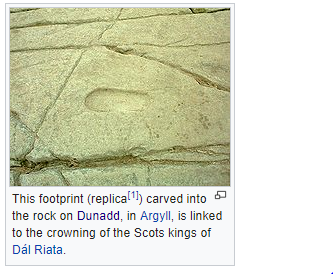
One day we will head north to Kilmarten Glen near Lochgilphead.  We traveled through this area last year on the bus and were intrigued by the vast area of stone circles, cupped rocks and burial cairns all along the road. Upon returning home we began to research the area and determined to return. We will climb Dunadd, and I plan on placing my foot firmly in the Footstep of  Fealty carved into the rock and proclaim myself King!

Well, someone needs to be the boss of everybody, eh?

After exploring the Kintyre and visiting a couple of whisky distilleries (Glen Scotia and Springbank) in Campbeltown, we will head to the Isle of Arran in the Firth of Clyde. This island is not technically in the ocean, rather, it is situated between the mainland and the Kintyre Peninsula. See the full Google map HERE.

Arran will delight us with hikes up mountains, more neolithic and stone age sites, treks along the ocean, waterfalls, vistas and fine fresh seafood. And a whisky distillery (Arran Distillery), cheese factory, bakery, art museum and more. We hope to climb Goatfell at 874 meters (2,867 feet), weather and feet and old legs dependent. Also on the agenda is Brodick Castle and grounds. We will be staying in Lochranza in the north, and Lamlash in the southeast.

We built a couple of days into the itinerary for time to explore more in Glasgow. We will stop along the way in Largs to learn about the Vikings in Scotland, plus Dumbarton Castle, sporting the longest recorded history of any stronghold in Scotland.

We opted for Aer Lingus and a layover in Dublin this year instead of flying Iceland Air into Reykjavik. A couple hours layover in an airport does not really count as a visit; however, I am adding Ireland to my meager "countries visited" resume.

Grandmothers Doilies Quilt


Over the years I have collected (by default, I think) doilies crocheted by both my grandmothers. My own mother gave me many of hers as she cleaned out her possessions; grandmothers gave me plenty as well.

What do do with them all? I use a fair number of them under lamps and plants and things to protect the furniture from scratching. I have too many of them; or perhaps I have too little furniture?

Whichever the case, I determined to preserve them in some fashion so I incorporated them into this disappearing nine-patch quilt.

I cut the doilies into sizes to fit a square and simply sewed them in with the next piece. The quilt is also full of old scraps from various eras and sewing projects of the past; a true memory quilt.

It is still only a quilt top; another in a growing pile of tops not yet quilted.


Denim Window Lap Quilt


This lively and lovely lap quilt was fun to make.

I cut circles from old denim jeans and sewed them right sides together to create a square in the center with "flaps". Into that square I put a variety of scraps, then sewed the curved flaps over the material in a serpentine pattern along the cut edges of the denim.

Once the quilt was washed the denim edges frayed, adding charm and definition to the overall pattern.

I would do this again; the quilt is heavy and the recipient of this quilt admits it is warm. This would make a great blanket to keep in the back of the car for any sort of emergency - a surprise picnic, padding for a delicate thrift store find, or a leg warmer on a cold road trip.

Op Art Rug


This rug took a looooong time to complete. Switching pitch in the middle of the loom was confusing - and I mean confusing on every row! Muscle memory is a challenge to change.

I envisioned this rug without the red middle stripe; however, as the rug progressed I realized that I should NOT have been twining from both ends. Had the two ends reached the middle the pattern would have been "off" by one warp twine. 

Next time, should there be one, I will only twine from one end.

You can tell I am still a novice at this color changing bit. I need to take more care with which weft is on top of the warp when I change the color. See the difference in the widths of the solid frame? They are exactly the same number of warps wide, but appear different widths due to the color of the weft going over the warp on top.

Folks have commented that this rug looks like a finger print; indeed it does. A fingerprint rug to collect footprints! I love the very thought and image.

I have a companion rug to this on the loom now; it will feature vertical "stripes" in red and white, plus some edge to edge same pitch twining.